I take in the "basket case" MPC wood canoes, the ones that no one else dares work on, fix them up good, and get the canoes back to camp.
This time I am working on a Peterborough low end Champlain. This is the only one that MPC has and it is a favourite of many paddlers. A few years ago it had the misfortune of being blown off of the canoe rack and was impaled upon the next rack. The gunnels were smashed, as well as four ribs, a bunch of planking, and, obviously, the canvas.

That cap at the center thwart hides a broken gunnel.

This deck will need replacing. While the work is competent it is entirely not in keeping with Peterborough methods.

Many of the rib ends are rotting and will have to be replaced. Also, you can see the rot that has set into the inner gunnels.

All those breaks and the rot mean only one thing: they have to be replaced. Here is a new pair of Fir inner gunnels with the sheer near the stem end being steam bent.

 There is a lot of wood to remove! Not much left, is there?
 And here they are installed. Now I am ready to replace the planking that has been removed.
 A long shot of the canoe all closed back up, sanded, and ready for varnishing of the interior. The interior requires a minimum of four coats of varnish, each coat sanded and cleaned of all dust before the next coat is applied. After the varnish is complete the canoe exterior can be prepared for canvassing.
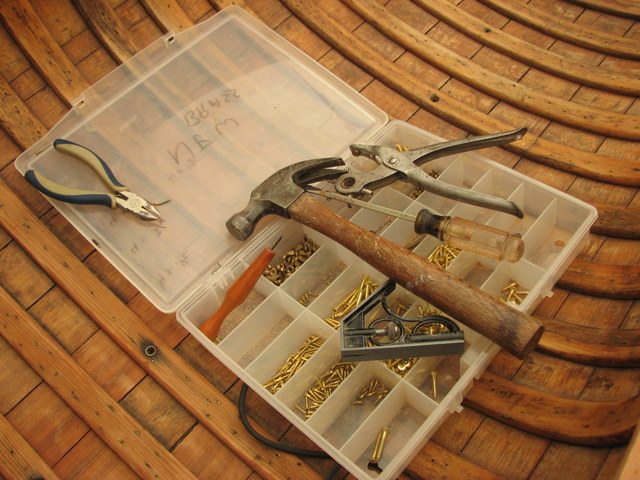
 These plastic boxes are great for holding all of the necessary fasteners that could be needed. It never fails that what you think that you will need does not include what you really need.